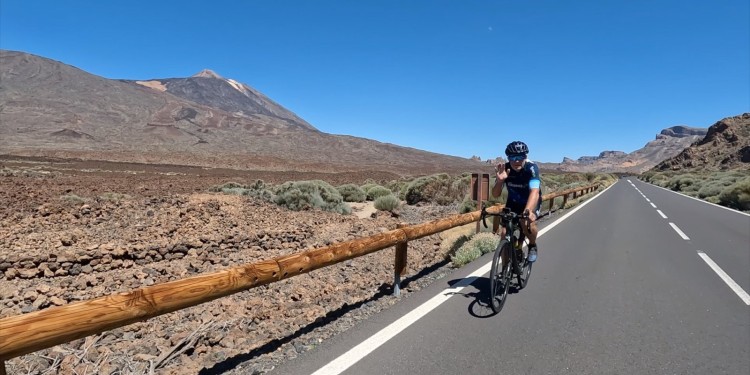
Cycling up Teide: the complete guide to every climb
Mount Teide is the reason many cyclists come to Tenerife. At 3,715 m it is the highest peak in Spain, and the roads that climb into its national park are among the longest continuous ascents in Europe: you can start at the sea and keep climbing for 40 km or more. Pro teams use them for winter training camps, but you don't need to be a pro to enjoy them. With the right route, the right bike and a bit of planning, reaching the crater is an unforgettable day out.
Here is everything you need to know before you ride up, from the four main climbs to the weather at 2,000 metres.
The four road climbs to Teide
All roads into Teide National Park end up on the same high plateau, around 2,000–2,300 m. The road itself tops out near the cable car station, at roughly 2,350 m. Distances and elevation vary a lot depending on where you start, so the figures below are approximate.
1. From the south via Vilaflor (TF-21)
The classic climb if you are staying in Costa Adeje, Los Cristianos or Playa de las Américas. From the coast you climb steadily to Vilaflor, the highest village in Spain at about 1,400 m, and then through a beautiful Canary pine forest to Boca Tauce, at the edge of the volcanic crater. Expect roughly 40–50 km and well over 2,000 m of climbing if you start at sea level. Gradients are mostly steady, around 5–7%, with very good road surfaces.
Best for: riders based in the south who want the full "sea to crater" experience.
2. From the west via Chío (TF-38)
Often described as the quietest way up. The road climbs from Chío through lava fields with views over La Gomera and reaches the park near Boca Tauce. It is a little less steep than the south climb and has less traffic, making it a great option for a first ascent.
Best for: a calmer climb with big views, easy to reach from Costa Adeje and the west coast.
3. From the north via La Orotava (TF-21)
The longest and, for many, the most beautiful. It starts in the historic town of La Orotava and climbs through farmland and a shaded pine forest up to El Portillo, the northern entrance to the park. Around 40 km and more than 2,000 m of elevation, with a few harder ramps on the lower slopes. The north side can be cloudy and cooler than the south.
Best for: strong riders looking for a long, scenic challenge.
4. From the northeast via La Esperanza (TF-24)
This road follows the volcanic ridge (the "Dorsal") through forest and past the Izaña observatory, with views over both coasts of the island. It joins the TF-21 near El Portillo. It is long rather than steep and is usually combined with other climbs in a big loop.
Best for: big loops and riders who want to see the whole island from above.
Which route should I ride from Costa Adeje?
If you are staying in the south, the most popular day is up via Vilaflor and down via Chío (or the other way round). It is a loop of about 100 km with more than 2,000 m of climbing, and it lets you see both the pine forest and the lava fields. If you want something shorter, you can turn around at Vilaflor or at the park entrance and still enjoy a great climb.
When to go and what the weather is like
You can ride Teide all year, but autumn, winter and spring are the most popular seasons. Keep in mind that the weather at the top has nothing to do with the beach:
- It is much colder up there. At 2,000 m the temperature can be 10–15 °C lower than on the coast, and in winter it can drop close to freezing, especially early in the morning.
- Wind can be strong on the plateau and on the descents.
- Snow happens. A few times each winter the roads into the park can close because of snow or ice. Check before you go.
- The sun is intense. The air is thin and dry, so use sun cream even when it feels cool.
What to bring
- A windproof jacket and arm warmers for the descent (even in summer).
- Two bottles and enough food: there are long stretches without shops. In the park itself there are only a few places to stop, such as the area around the Parador hotel and the cable car.
- Some cash or a card for a coffee in Vilaflor.
- Lights if you start early or finish late, and a phone with the route loaded.
Which bike should I hire?
- Lightweight road bike: the natural choice for climbing. Our Bianchi and Giant 2027 road bikes come with compact gearing that makes long climbs much easier.
- E-road or e-MTB: perfect if you want to reach the crater without being an experienced climber, or if you are riding with friends of different levels. Check the battery range for your route before you go.
- Gravel bike: a good option if you want to combine the climb with some of the dirt tracks around the national park.
Whatever you ride, get the bike fitted to your measurements before a long climb. Small adjustments to saddle height and reach make a big difference after two or three hours of climbing.
Ride Teide with Bike Experience Tenerife
Our shop is in Costa Adeje (C.C. Paraíso del Sol), right at the start of the southern routes up to Teide. We can deliver your bike to your hotel in the Costa Adeje area free of charge for rentals of three days or more, set it up to your measurements and give you route tips for the day. If you prefer not to ride alone, join one of our guided routes: we adapt the ride to the group and provide water along the way.
Check availability and book your bike online →
Frequently asked questions
How long does it take to cycle up Teide?
For most amateur riders, the climb from the south coast to the park takes between 3 and 5 hours, depending on fitness and stops. A full loop with the descent is usually a whole morning or day out.
Can you cycle to the summit of Teide?
No. The road ends on the plateau, around 2,300 m. The last stretch to the 3,715 m summit is reached by cable car and a short walk that requires a permit.
Is it possible with an e-bike?
Yes. An e-bike is a great way to enjoy the climb at your own pace. Plan your route according to the battery range and the support level you use.
Do I need to be very fit?
It is a long climb, but the gradients are mostly steady. If you ride regularly and take it easy, it is achievable. If in doubt, choose a shorter route, an e-bike or a guided ride.